
Japanese Names That Literally Mean Flower or Blossom
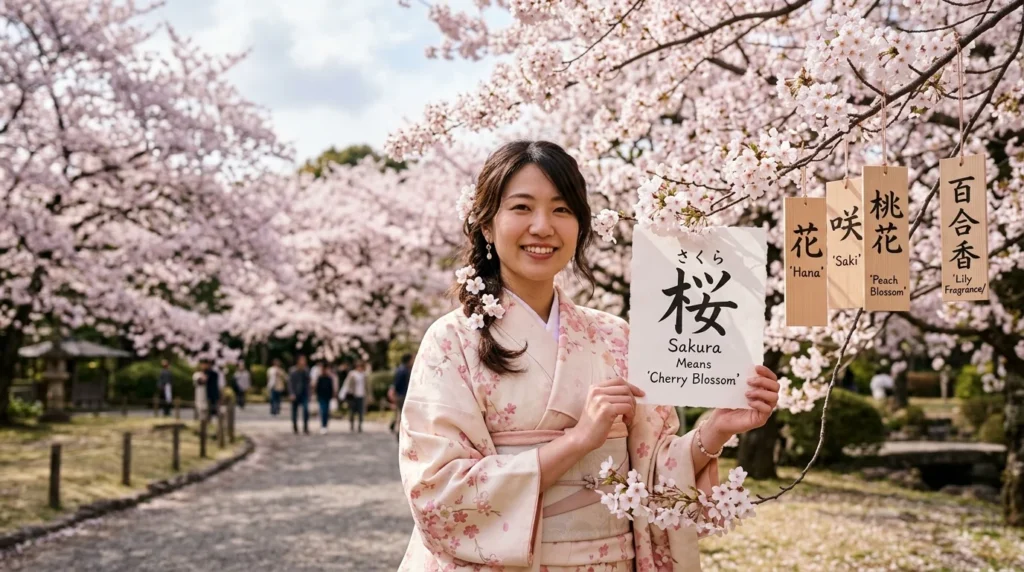
The Japanese word hana (花) means “flower” and is one of the clearest ways to express a floral meaning. Several Japanese names use 花 or other flower-related kanji.
- Hana (花) — Flower
- Hanako (花子) — Flower child
- Hanami (花美) — Flower beauty
- Hanayo (花世) — Flower generation
- Hanaka (花香) — Flower fragrance
- Hanane (花音) — Flower sound
- Hanaho (花穂) — Flower ear
- Hanari (花莉) — Flower and jasmine
- Hanami (花実) — Flower fruit
- Hanano (花乃) — Of the flower
- Hanae (花恵) — Flower blessing
- Hanamiya (花宮) — Flower shrine
- Hanaka (花花) — Floral association
- Karin (花梨) — Quince
- Kaori (花織) — Flower weave
- Kanon (花音) — Flower sound
- Karen (花蓮) — Flower lotus
- Kanade (花奏) — Flower melody
- Hanaho (花歩) — Flower walk
- Hanase (花瀬) — Flower rapids
Hana is the simplest and most direct choice. Names containing 花 can offer more specific floral imagery depending on the other kanji.
Japanese Girl Names That Mean Blossom
Floral names are especially common in Japanese feminine naming because flowers can symbolize beauty, seasons, grace, and growth.
- Hana (花) — Flower
- Hanako (花子) — Flower child
- Hanami (花美) — Flower beauty
- Hanaka (花香) — Flower fragrance
- Hanane (花音) — Flower sound
- Hanayo (花世) — Flower generation
- Hanaho (花穂) — Flower ear
- Hanari (花莉) — Flower and jasmine
- Sakura (桜) — Cherry blossom
- Sakurako (桜子) — Cherry blossom child
- Sakurane (桜音) — Cherry blossom sound
- Sakuraka (桜香) — Cherry blossom fragrance
- Sakurami (桜美) — Cherry blossom beauty
- Sakurayo (桜世) — Cherry blossom world
- Ayame (菖蒲) — Iris
- Botan (牡丹) — Peony
- Sumire (菫) — Violet
- Tsubaki (椿) — Camellia
- Yuri (百合) — Lily
- Ren (蓮) — Lotus
Sakura is one of the most recognizable Japanese flower names. Sumire, Tsubaki, Botan, and Yuri offer other traditional floral images.
Japanese Names Inspired by Cherry Blossoms
Cherry blossoms, or sakura (桜), are deeply associated with spring and Japanese culture. Names using 桜 can evoke beauty, renewal, and the fleeting nature of blossoms.
- Sakura (桜) — Cherry blossom
- Sakurako (桜子) — Cherry blossom child
- Sakurane (桜音) — Cherry blossom sound
- Sakuraka (桜香) — Cherry blossom fragrance
- Sakurami (桜美) — Cherry blossom beauty
- Sakurayo (桜世) — Cherry blossom world
- Sakuraha (桜葉) — Cherry blossom leaf
- Sakurano (桜乃) — Of the cherry blossom
- Sakuraho (桜穂) — Cherry blossom ear
- Sakurame (桜芽) — Cherry blossom bud
- Sakurane (桜音) — Cherry blossom sound
- Sakuraki (桜樹) — Cherry blossom tree
- Sakuraba (桜葉) — Cherry blossom leaf
- Sakuragi (桜木) — Cherry tree
- Sakurayuki (桜雪) — Cherry blossom snow
- Sakurae (桜恵) — Cherry blossom blessing
- Sakuraha (桜花) — Cherry blossom
- Ohana (桜花) — Cherry blossom
- Ouka (桜花) — Cherry blossom
- Otoha (桜音) — Blossom sound
Some of these are creative kanji combinations rather than claims of common traditional given names. Always verify the specific name and characters before using one officially.
Japanese Names That Mean Bloom
The idea of “blooming” can be expressed through kanji associated with flowers, buds, opening, and growth.
- Saki (咲) — Bloom
- Sakiko (咲子) — Blooming child
- Sakina (咲奈) — Blooming name combination
- Sakino (咲乃) — Of blooming
- Sakika (咲花) — Blooming flower
- Sakine (咲音) — Blooming sound
- Sakimi (咲美) — Blooming beauty
- Sakiyo (咲世) — Blooming world
- Sakie (咲恵) — Blooming blessing
- Sakika (咲香) — Blooming fragrance
- Sakura (桜) — Cherry blossom
- Emi (咲美) — Blooming beauty
- Emina (咲奈) — Blooming-inspired combination
- Misaki (美咲) — Beautiful bloom
- Misaki (美咲) — Beauty and bloom
- Sakaho (咲穂) — Blooming ear
- Sakine (咲音) — Blooming sound
- Sakiyo (咲代) — Blooming generation
- Sakumi (咲美) — Blooming beauty
- Sakurae (咲良) — Good and blooming
Saki (咲) is particularly important because 咲 means “to bloom” or “to blossom” and appears in many Japanese names.
Japanese Girl Names With Flower Meanings
If you want a Japanese name associated with a specific flower, there are many elegant choices.
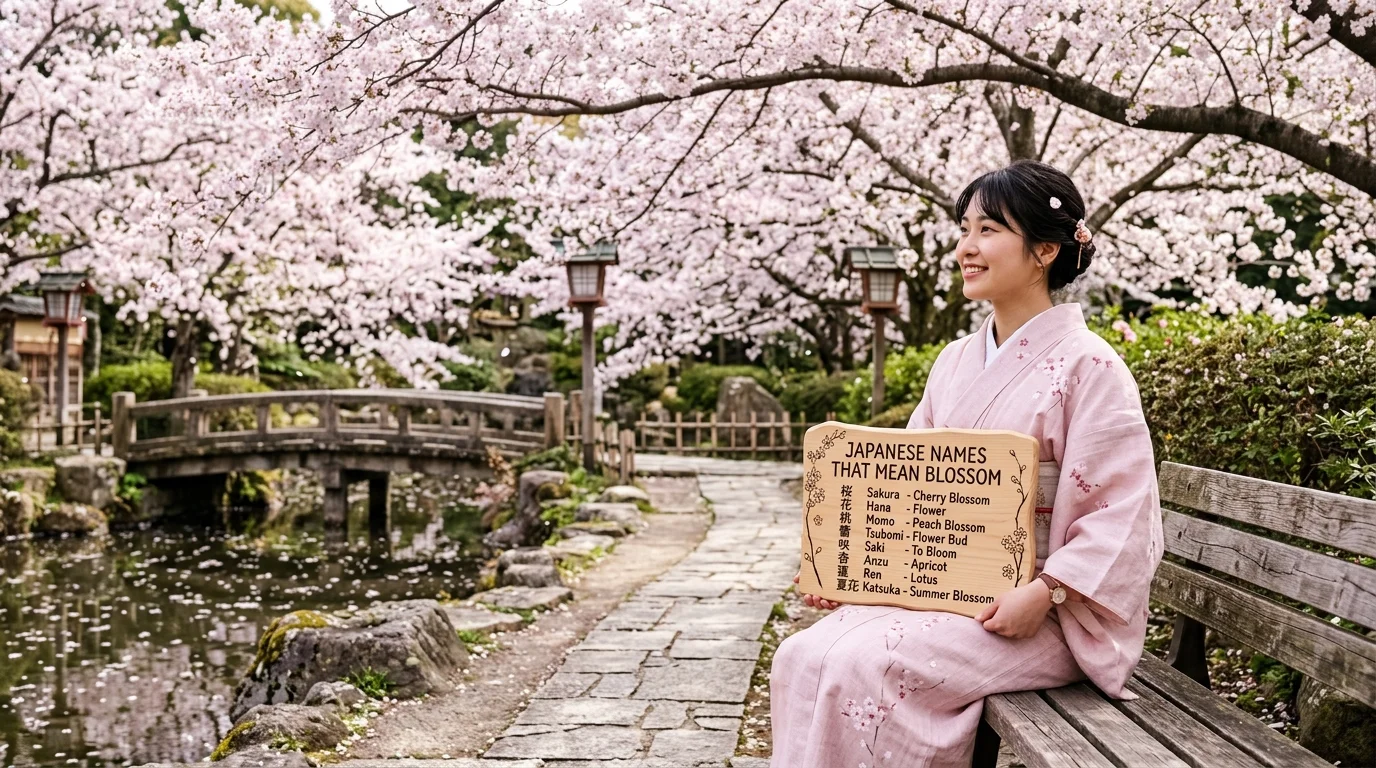
- Sakura (桜) — Cherry blossom
- Hana (花) — Flower
- Yuri (百合) — Lily
- Sumire (菫) — Violet
- Ayame (菖蒲) — Iris
- Botan (牡丹) — Peony
- Tsubaki (椿) — Camellia
- Ume (梅) — Plum blossom
- Momo (桃) — Peach
- Ran (蘭) — Orchid
- Kiku (菊) — Chrysanthemum
- Fuji (藤) — Wisteria
- Asagao (朝顔) — Morning glory
- Himawari (向日葵) — Sunflower
- Ajisai (紫陽花) — Hydrangea
- Suzuran (鈴蘭) — Lily of the valley
- Ayaka (彩花) — Colorful flower
- Hanaka (花香) — Flower fragrance
- Kaori (花織) — Flower weave
- Karen (花蓮) — Flower lotus
Ume, Fuji, Ran, and Kiku are especially interesting if you want a name based on a specific traditional Japanese flower.
Japanese Names Inspired by Petals
Petals add a softer image than the flower itself. They suggest delicacy, beauty, and the gentle movement of blossoms.
- Hana (花) — Flower
- Sakura (桜) — Cherry blossom
- Sakurae — Cherry blossom-inspired
- Hanane (花音) — Flower sound
- Hanaka (花香) — Flower fragrance
- Hanami (花美) — Flower beauty
- Hanaho (花穂) — Flower ear
- Hanayo (花世) — Flower world
- Hanari (花莉) — Flower and jasmine
- Sakuraha (桜葉) — Cherry blossom leaf
- Sakuraka (桜香) — Cherry blossom fragrance
- Sakurami (桜美) — Cherry blossom beauty
- Sakurane (桜音) — Cherry blossom sound
- Sakurayuki (桜雪) — Cherry blossom snow
- Hanairo (花色) — Flower color
- Hanashiro (花白) — Flower white
- Hanakaze (花風) — Flower wind
- Hanakumo (花雲) — Flower cloud
- Hanabira — Petal
- Hanagasumi (花霞) — Flower haze
Some poetic compounds here are better suited to fictional characters or creative naming than everyday given names.
Japanese Names Inspired by Spring Blossoms
Spring is the season most strongly linked with blooming flowers. These names combine floral imagery with renewal and new beginnings.
- Haru (春) — Spring
- Haruka (春香) — Spring fragrance
- Haruna (春菜) — Spring greens
- Harumi (春美) — Spring beauty
- Harue (春恵) — Spring blessing
- Haruno (春乃) — Of spring
- Haruka (春花) — Spring flower
- Haruka (春香) — Spring fragrance
- Harumi (春美) — Spring beauty
- Haruna (春奈) — Spring-inspired name
- Sakura (桜) — Cherry blossom
- Ume (梅) — Plum blossom
- Momo (桃) — Peach
- Hana (花) — Flower
- Saki (咲) — Bloom
- Misaki (美咲) — Beautiful bloom
- Hanami (花見) — Flower viewing
- Hanako (花子) — Flower child
- Sakurako (桜子) — Cherry blossom child
- Haruka (春花) — Spring flower
Haru and names containing 春 are especially useful if you want the broader feeling of spring rather than one particular flower.
Japanese Unisex Names Related to Blossoms
Some Japanese names can work across genders depending on the kanji and naming context.
- Hana (花) — Flower
- Saki (咲) — Bloom
- Ren (蓮) — Lotus
- Haru (春) — Spring
- Sakura (桜) — Cherry blossom
- Kaede (楓) — Maple
- Aoi (葵) — Hollyhock
- Ran (蘭) — Orchid
- Momo (桃) — Peach
- Ume (梅) — Plum blossom
- Itsuki (樹) — Tree
- Hinata (陽向) — Facing the sun
- Akira (明) — Bright
- Kaoru (薫) — Fragrance
- Nao (尚) — Meaning varies by kanji
- Rei (玲) — Meaning varies by kanji
- Yuki (雪) — Snow
- Kō (光) — Light
- Kei (圭) — Meaning varies by kanji
- Ren (蓮) — Lotus
The exact gender association can vary with kanji, generation, and naming style, so check the specific form if you are choosing a real-world name.
Rare Japanese Flower Names
For something less common, consider flowers that are not as frequently used in everyday naming.
- Ayame (菖蒲) — Iris
- Botan (牡丹) — Peony
- Tsubaki (椿) — Camellia
- Ran (蘭) — Orchid
- Fuji (藤) — Wisteria
- Ume (梅) — Plum blossom
- Suzuran (鈴蘭) — Lily of the valley
- Ajisai (紫陽花) — Hydrangea
- Asagao (朝顔) — Morning glory
- Kiku (菊) — Chrysanthemum
- Momo (桃) — Peach
- Himawari (向日葵) — Sunflower
- Yuri (百合) — Lily
- Sumire (菫) — Violet
- Hasu (蓮) — Lotus
- Ren (蓮) — Lotus
- Kaede (楓) — Maple
- Aoi (葵) — Hollyhock
- Nadeshiko (撫子) — Dianthus
- Kikyo (桔梗) — Bellflower
Kikyo, Nadeshiko, Suzuran, and Ajisai are especially distinctive choices for floral inspiration.
Japanese Names That Mean Beautiful Blossom
If you want the meaning to combine beauty and flowers, names using 美 (mi, beauty) and flower-related kanji can create lovely combinations.
- Misaki (美咲) — Beautiful bloom
- Hanami (花美) — Flower beauty
- Sakurami (桜美) — Cherry blossom beauty
- Hanabina (花美) — Flower beauty-inspired
- Hanamiya (花美) — Flower beauty-inspired
- Hanami (花美) — Flower beauty
- Sakumi (咲美) — Blooming beauty
- Emi (咲美) — Blooming beauty
- Hanami (華美) — Floral elegance
- Hanabishi (花美) — Flower beauty-inspired
- Ayaka (彩花) — Colorful flower
- Ayame (彩芽) — Colorful bud
- Hanaka (花香) — Flower fragrance
- Sakika (咲香) — Blooming fragrance
- Sakuraka (桜香) — Cherry blossom fragrance
- Hanane (花音) — Flower sound
- Sakurae (桜恵) — Cherry blossom blessing
- Hanae (花恵) — Flower blessing
- Hanako (花子) — Flower child
- Sakurako (桜子) — Cherry blossom child
Kanji combinations can have different readings and levels of naturalness, so these should be checked individually before official use.
Japanese Names Inspired by Nature and Blossoming
Blossoms are part of a larger natural world. These names capture trees, leaves, light, spring, and other imagery associated with flowering.
- Kaede (楓) — Maple
- Itsuki (樹) — Tree
- Aoi (葵) — Hollyhock
- Haru (春) — Spring
- Hinata (陽向) — Sun-facing
- Hikari (光) — Light
- Akari (明里) — Bright village
- Yuki (雪) — Snow
- Kaze (風) — Wind
- Tsuki (月) — Moon
- Hoshi (星) — Star
- Nami (波) — Wave
- Mori (森) — Forest
- Hayashi (林) — Woods
- Umi (海) — Sea
- Sora (空) — Sky
- Ame (雨) — Rain
- Niji (虹) — Rainbow
- Asa (朝) — Morning
- Akane (茜) — Madder red
These choices are ideal if you want the feeling of blossoms and nature without using a flower word directly.